Project Management

Effective task management is the backbone of any well-run operation — but there is a specific, predictable moment when it starts to break down. Not when a project gets complicated. Not when a deadline shifts. It breaks down the moment your team grows past ten people. What worked at five or seven — the shared Slack channel, the weekly standup, the mental map in your head — quietly stops scaling. And by the time you notice the cracks, the cost is already compounding.
This is not a people problem. It is a structural one. Research from McKinsey shows that employees spend nearly 20% of their working week searching for internal information or tracking down colleagues for status updates. At a ten-person team working 40-hour weeks, that is the equivalent of one full-time employee doing nothing but chasing answers. Every week. That is not inefficiency — that is a structural tax on your growth.
The good news: this breakdown follows a recognizable pattern. And patterns can be mapped, named, and fixed. This article gives you a repeatable framework to diagnose exactly where your task management clarity collapses at scale — and what to do about it before it stalls your team entirely.
The Compounding Cost of Clarity Loss in Task Management
Every time a team member cannot find task context, a small amount of time is lost. But that loss is not linear — it compounds. A missed handoff creates a delay. A delay creates a follow-up message. That message gets buried in chat. Someone makes a decision with incomplete information. That decision requires a correction. Each of those events pulls in at least one other person.
According to Asana's Anatomy of Work report, 58% of workers say unclear priorities are one of their top productivity killers. For operations managers, unclear priorities translate directly into duplicated effort, missed SLAs, and onboarding failures when new hires inherit broken systems. The task tracking problem is not just a productivity issue — it is an organizational risk.
The ten-person threshold matters because it is where informal coordination systems hit their natural ceiling. Below ten, most people share enough context passively. Above ten, you need deliberate structure. Without it, you pay what we call the Clarity Tax — a hidden, recurring cost absorbed by your most capable people.
Symptom | Root cause at 10+ people | Estimated weekly cost per person |
|---|---|---|
Chasing status updates | No centralized task workflow | 3–5 hours |
Duplicated work | No shared task visibility | 2–4 hours |
Slow onboarding | Knowledge silos, no task templates | 4–6 hours (new hire) |
Missed deadlines | No task tracking accountability | Variable, high-impact |
The SCOPE Framework: A Task Management Model for Growing Teams
To diagnose and fix clarity loss in task management, you need a model that addresses the actual failure points — not just a to-do list upgrade. The SCOPE Framework maps the five structural layers where task coordination breaks down at scale. SCOPE stands for: Standardization, Context, Ownership, Progress Visibility, and Escalation Paths. Each layer is a prerequisite for the next. Miss one, and the whole system leaks.
The framework is designed for operations managers who need to move fast without deploying enterprise-grade complexity. It works whether your team is transitioning from informal coordination or inheriting a patchwork of tools that never quite fit together.
S — Standardization: Where Task Management Breaks First
Without standardized task workflows, every team member invents their own system. One person tracks tasks in a spreadsheet. Another uses sticky notes. A third buries action items in email threads. When something falls through the cracks — and it will — you cannot diagnose why, because there is no common structure to audit.
Standardization means defining: what a task looks like (title, owner, due date, priority, linked context), where tasks live, and how they move through stages. This is not bureaucracy — it is the operating system for your team's work. Without it, every new hire has to reverse-engineer how things get done. With it, onboarding time drops significantly because the system itself is the teacher.
Ops example: A customer success team of 12 was handling client onboarding differently across every account manager. Some used email, some used shared docs, some kept it all in their heads. Standardizing a single task workflow — from kickoff to completion — reduced onboarding inconsistencies by cutting the average time to first client milestone by nearly a third.
C — Context: The Task Tracking Detail That Actually Gets Work Done
A task without context is just a label. "Update landing page" tells a team member what to do, but not why it matters, what the constraints are, or what "done" looks like. Context is the difference between a task that gets completed correctly on the first attempt and one that generates three follow-up conversations.
Context includes: the decision or request that triggered the task, any relevant files or reference materials, dependencies on other tasks, and the definition of done. When context lives in a separate email thread or buried in a chat history, it is effectively lost. Task management systems that attach context directly to the task card eliminate that loss.
Ops example: A marketing coordinator spent 45 minutes per day re-explaining background context to designers because the original briefs lived in email. Attaching briefs, brand guidelines, and approval history directly to each task card eliminated that overhead entirely — and cut revision cycles in half.
Weekly Hours Lost Per Employee Due to Poor Task Clarity
7.5 hrs
No system (informal)
5.2 hrs
Partial tools (chat/email)
1.8 hrs
Structured task workflow
Fig 1: Estimated weekly hours lost per employee by coordination method (illustrative, based on McKinsey and Asana research)
O — Ownership: Assigning Task Accountability at Scale
Shared ownership is usually no ownership. When a task is assigned to a team rather than a named individual, the implicit assumption is that someone else will handle it. This is one of the most common task management failures at growing SMBs — and one of the easiest to fix structurally.
Every task needs a single accountable owner, even when multiple people contribute. That owner is responsible for either completing the task or escalating it when blocked. This does not mean one person does all the work. It means one person is the point of accountability — and that clarity alone eliminates the most common source of deadline slippage.
Ops example: An operations team running a quarterly vendor review had tasks split across procurement, finance, and legal. Nobody owned the consolidated report. Three days before the board meeting, the report did not exist. Assigning a single task coordinator — with sub-tasks delegated to each function — ensured the next cycle completed on time with zero chasing required.
P — Progress Visibility: Real-Time Task Tracking Without the Status Meeting
If the only way to know where a project stands is to ask someone, your task tracking system is not working. Progress visibility means any stakeholder — including you, as the ops manager — can see the current state of any task or project without interrupting the person doing the work.
This is where most growing teams still rely on status meetings, weekly check-ins, or manual update emails. Those methods are not just slow — they create a false sense of control. A task can be marked "in progress" for two weeks while the actual work is blocked. Real task visibility requires status stages that reflect actual workflow states: not just "to-do / doing / done," but "waiting for input," "blocked," "in review," and so on.
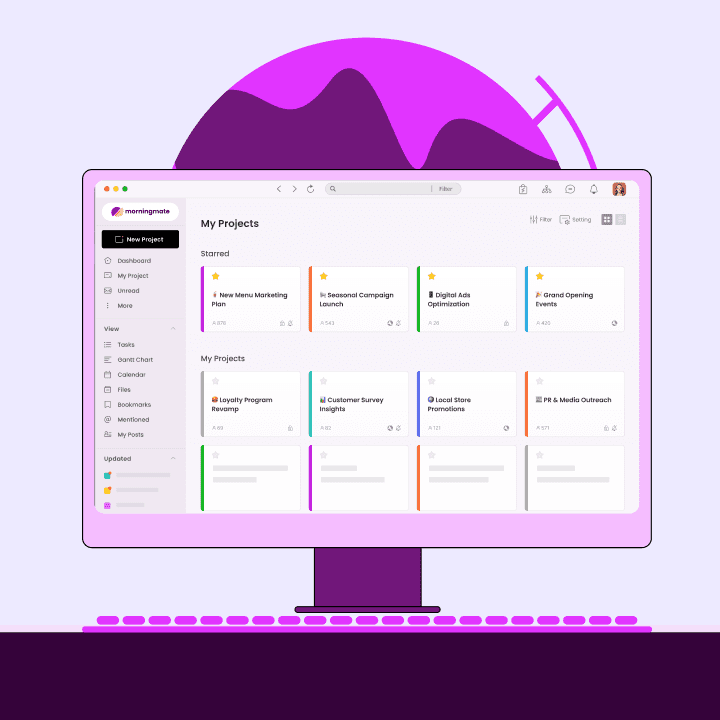
This is where a tool like Morningmate — a lightweight work management platform used by over 550,000 teams — becomes operationally significant. Its task management layer gives every team member a live view of task status across projects, without requiring a dedicated project manager to curate updates. Tasks, files, and comments live in one place, so progress is visible by default rather than by request.
E — Escalation Paths: The Task Management Layer Most Teams Skip
When a task is blocked, what happens next? In most growing teams, the answer is: the person doing the work sends a message into the void and hopes someone picks it up. That is not a system — that is luck. Escalation paths define exactly what a team member should do when they cannot move forward: who to flag, how to flag it, and what the expected response time is.
Escalation paths also protect operations managers from becoming the default solution to every blocked task. When the path is clear, the team self-directs. When it is not, everything escalates to the person with the most visibility — which is usually you.
Ops example: A logistics team introduced a simple rule: any task blocked for more than 24 hours must have a "blocked" tag and a comment tagging the relevant decision-maker. Resolution time on blocked tasks dropped from an average of four days to under 18 hours within the first month.
Applying the SCOPE Framework in Morningmate: A Worked Task Management Example
Here is how the SCOPE framework maps to a real standardized workflow using Morningmate's task management features. The scenario: onboarding a new client across sales, ops, and customer success.
Standardization: Create a repeatable project template in Morningmate with pre-defined task stages — Contract Signed, Kickoff Scheduled, Access Provisioned, Training Complete, Go-Live. Every new client onboarding starts from this template. No rebuilding from scratch, no missing steps.
Context: Each task card in Morningmate holds the relevant files, links, and notes directly in the task. The signed contract, kickoff agenda, and welcome email template are attached at the point of creation — not scattered across email inboxes.
Ownership: Every task is assigned to one named person. Sub-tasks within "Kickoff Scheduled" — calendar invite, agenda prep, stakeholder briefing — each have their own owner. The customer success manager owns the parent task and is accountable for the milestone.
Progress Visibility: Morningmate's feed view gives the ops manager a live, social-media-style view of updates across all active onboardings. No status meeting needed. A quick scroll shows which clients are on track and which have stalled tasks — surfacing issues before they become escalations.
Escalation: Morningmate's built-in chat (with a familiar interface similar to WhatsApp) is used for flagging blocks — but linked directly to the relevant task, not buried in a general channel. The escalation is contextualized, time-stamped, and visible to the right people without broadcasting to the entire team.
SCOPE Layer | Manual / ad-hoc approach | Standardized with Morningmate |
|---|---|---|
Standardization | Rebuilt every time from memory | Reusable task templates, consistent every time |
Context | Scattered across email, chat, Drive | Files and notes attached directly to tasks |
Ownership | Assumed, not assigned | Named owner per task and sub-task |
Progress Visibility | Weekly status meetings, manual emails | Live feed view, real-time task tracking |
Escalation | Ad-hoc messages, unclear path | Task-linked chat with defined escalation rules |
Task Coordination Improvement After Adopting SCOPE Framework (% of Teams Reporting Improvement)
41%
Fewer missed deadlines
63%
Faster onboarding
78%
Reduced status chasing
Fig 2: Reported operational improvements after implementing structured task management (illustrative, based on industry benchmarks)
Task Management Implementation Checklist: Getting SCOPE in Place
Overhauling your task coordination approach does not require a months-long rollout. Start with the most broken layer and work forward. Here is a sequenced checklist for operations managers ready to install clarity at scale.
Week 1 — Standardization: Define what a task must include (title, owner, due date, stage, context). Build one template for your most repeated workflow and make it mandatory.
Week 1–2 — Context: Audit your three most active projects. Identify where context is living outside the task. Migrate it in. Set the rule: if it is not on the task card, it does not count.
Week 2 — Ownership: Review every open task across your team. Any task with no named individual owner gets one assigned immediately. No group assignments.
Week 2–3 — Progress Visibility: Implement at minimum four task stages that reflect your actual workflow. Replace one recurring status meeting with a live task tracking view — and hold the line on keeping it replaced.
Week 3–4 — Escalation: Define and publish your escalation rule. Example: "Any task blocked for more than 24 hours must be flagged with a 'blocked' status and a comment tagging the relevant owner." Run it for two weeks and measure resolution time.
Ongoing — Reinforce: Review your task management system monthly. Identify which layer is leaking. Fix it before it compounds.
Project clarity does not disappear randomly. It erodes at predictable points as teams grow, and it erodes fastest in teams that never installed structure because they never needed it before. The task management habits that worked at five people are liabilities at fifteen. The SCOPE framework gives you a diagnostic tool and a build sequence — so that your next ten hires inherit a system, not a mess. Learn more about standardizing team workflows as your SMB scales.